
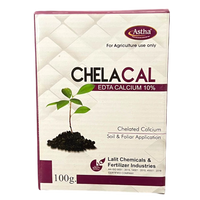
Chelated Calcium EDTA 10% – Uses, Dosage & Application
Currently none of our products with this technical are in stock. Please check back soon, or browse our full product range.
Chelated Calcium EDTA 10% is a fully water-soluble, chelated secondary-nutrient fertilizer registered for use in India under the Fertilizer (Control) Order, 1985 (FCO) — a plant-nutrition product, not a crop-protection one. Calcium is essential for cell wall strength and structure, and unlike more mobile nutrients, it moves poorly within the plant once absorbed, so deficiency shows up specifically in the youngest growing tissue and in the developing fruit itself, even when soil calcium levels are adequate. Dosage guidance on this page draws on ICAR and state agricultural university research on calcium-deficiency physiological disorders in fruiting and vegetable crops, read alongside the product's own FCO label application rate for this chelated formulation.
Which Deficiency Symptom Is This For? (Symptom Guide)
Not sure whether what you're seeing in the field is calcium deficiency? This guide helps match the visible symptom to the crop before deciding on a spray.
| Crop | Other Names | What You'll See in the Field |
|---|---|---|
| Tomato | Blossom end rot. | A sunken, water-soaked, dark brown to black patch forms at the blossom end (bottom tip) of the fruit, opposite the stem, most common during hot, dry spells or with uneven watering. |
| Cabbage / Cauliflower | Tip burn. | The margins of young, inner (wrapper) leaves turn brown and dry out or scorch, most visible on leaves closest to the growing head, since calcium cannot move into fast-growing tissue fast enough. |
| Capsicum / Chilli | Blossom end rot. | Similar to tomato: a sunken, dark, leathery patch develops at the fruit's blossom end, and affected fruit can develop secondary fungal rot at the same spot. |
| Groundnut | Pod-filling disorder / "pops". | Poorly filled, shrivelled or unfilled ("pops") pods at harvest, since calcium must be absorbed directly by the developing pod in the soil (the "gynophore/peg zone") rather than through the leaves alone. |
| Apple | Bitter pit. | Small, sunken, dark spots appear on and just under the fruit skin, sometimes only becoming visible in storage after harvest, giving the flesh underneath a dry, bitter, corky texture. |
Mode of Action
Calcium EDTA is a chelated form of calcium in which the calcium ion is bound within an EDTA (ethylenediaminetetraacetic acid) molecule, keeping it soluble and readily absorbable by the leaf when sprayed. Calcium is a structural component of the cell wall (as calcium pectate) and plays a role in cell membrane stability and cell division; because it moves almost entirely through the plant's xylem (water-conducting tissue, driven by transpiration) rather than being redistributed through the phloem, calcium supplied to older leaves does not reach fast-growing new tissue or fruit — deficiency symptoms are therefore localised to the youngest leaves and the fruit itself, and are corrected only by getting calcium directly to those tissues via a targeted, repeated foliar spray rather than a single soil application.
Features & Benefits
- Fully water-soluble, chelated calcium source that reaches the fruit and young leaf tissue directly through foliar spray, where soil-applied calcium often cannot.
- Corrects blossom end rot in tomato and capsicum/chilli, tip burn in cabbage/cauliflower, bitter pit in apple and pod-filling disorders in groundnut.
- Chelation keeps calcium available for foliar uptake without the antagonism/precipitation problems calcium salts can have with phosphates and sulphates.
- Improves fruit firmness, shelf life and post-harvest storage quality alongside correcting the physiological disorder itself.
- Compatible with most common fertilizers and crop-protection products in a tank mix (a jar-compatibility test is still recommended before mixing, especially with sulphate or phosphate fertilizers).
Recommended Usage of Chelated Calcium EDTA 10% Fertilizer
Because calcium deficiency disorders are corrected by direct, repeated foliar contact with the affected tissue rather than a single per-hectare soil dose, ICAR and university extension guidance for these crops is expressed as a foliar spray concentration with a repeat schedule through the fruiting/heading period, rather than a one-time application.
| Crop | Recommended Dose | Water Volume | Application Timing/Method |
|---|---|---|---|
| Tomato | 1 g per litre (0.1% solution) | As a fine foliar spray targeting flower clusters and young fruit | Starting at flowering/early fruit-set, repeated every 10–15 days through fruit development, especially in hot or dry weather |
| Cabbage / Cauliflower | 1 g per litre (0.1% solution) | As a fine foliar spray targeting the growing point/young leaves | From early head formation, repeated every 10–15 days until harvest |
| Capsicum / Chilli | 1 g per litre (0.1% solution) | As a fine foliar spray targeting flower clusters and young fruit | Starting at flowering/early fruit-set, repeated every 10–15 days through fruit development |
| Groundnut | 1–2 g per litre (0.1–0.2% solution) | As a fine foliar spray, directed to reach the pegging/pod zone near the soil surface where possible | At pegging (flowering to peg entry into soil), repeated 2–3 times at 15-day intervals during pod development |
| Apple | 1–2 g per litre (0.1–0.2% solution) | As a fine foliar spray to full fruit coverage | From 3–4 weeks after fruit set, repeated every 10–15 days, with the last spray close to harvest for bitter-pit-prone orchards |
Doses above are expressed as a percentage/concentration rather than a per-acre quantity because chelated calcium foliar sprays are dosed by the concentration of the spray solution, not by land area, and because these disorders are corrected only by repeated, targeted contact with the affected tissue rather than a single soil dose. Always confirm the current product label before use and consult your local agricultural extension office for crop-specific guidance.
How to Use
- Confirm calcium deficiency symptoms against the Symptom Guide above — these disorders appear on fruit or young leaf tissue specifically, not as general yellowing across the plant, which helps distinguish them in the field.
- Dissolve the required quantity of Chelated Calcium EDTA 10% fully in a small amount of water first, then add it to the spray tank and top up to the required volume while stirring.
- Spray using a knapsack or power sprayer fitted with a fine mist nozzle, directing coverage specifically at flower clusters, young fruit or the growing point, since calcium barely moves once it reaches older leaf tissue.
- Spray during the early morning or late evening to reduce evaporation and improve uptake; avoid spraying in strong sunlight or just before rain.
- Begin spraying preventively from flowering/early fruit-set in disorder-prone crops and weather (hot, dry spells or uneven watering) rather than waiting for symptoms to appear, and repeat at the interval given in the table above through the fruiting/heading period.
Precautions & Safety
- Wear basic protective clothing and gloves while mixing and spraying, as a routine precaution for any agricultural input.
- Do not exceed the recommended concentration — spraying calcium at a higher-than-labelled concentration can cause leaf or fruit-surface scorch rather than faster correction.
- Avoid tank-mixing with sulphate or phosphate fertilizers without a jar-compatibility test first, since calcium can react with them to form an insoluble precipitate that reduces effectiveness and can block sprayer nozzles.
- Store in the original, tightly closed container in a cool, dry place away from direct sunlight, food, feed and out of reach of children and livestock.
- Calcium sprays correct the physiological disorder in the current crop but do not carry over to the next planting — repeat the spray programme each season in disorder-prone fields, alongside consistent irrigation to reduce moisture-stress triggers.
- Wash hands, face and any exposed skin thoroughly with soap and water after handling or spraying.
Brand names mentioned on this page are registered trademarks of their respective owners and are referenced here for identification purposes only; FarmMate is not affiliated with or endorsed by these brands. This page is for general information only — always consult your local agricultural extension office and confirm the current product label before use.
Explore other technical usage guides on FarmMate.in
Fertilizers8
Micronutrients9
Fungicides34
- Azoxystrobin 11% + Tebuconazole 18.3% SC
- Azoxystrobin 18.2% + Difenoconazole 11.4% SC
- Azoxystrobin 23% SC
- Azoxystrobin 11.5% + Mancozeb 30% WP
- Azoxystrobin 4.8% + Chlorothalonil 40% SC
- Captan 70% + Hexaconazole 5% WP
- Carbendazim 12% + Mancozeb 63% WP
- Carbendazim 46.27% SC
- Carbendazim 50% WP
- Copper Oxychloride 50% WP
- Cymoxanil 8% + Mancozeb 64% WP
- Hexaconazole 5% SC
- Isoprothiolane 40% EC
- Mancozeb 75% WP
- Metalaxyl 35% WS
- Metalaxyl 8% + Mancozeb 64% WP
- Propiconazole 25% EC
- Propineb 70% WP
- Streptomycin Sulphate 9% + Tetracycline Hydrochloride 1%
- Sulphur 80% WDG
- Tebuconazole 10% + Sulphur 65% WG
- Tebuconazole 25.9% EC
- Tebuconazole 25% WG
- Tebuconazole 2% DS
- Tebuconazole 50% + Trifloxystrobin 25% WG
- Tebuconazole 6.7% + Captan 26.9% SC
- Thifluzamide 24% SC
- Tebuconazole 38.39% SC
- Thiophanate Methyl 70% WP
- Tricyclazole 75% W.P.
- Validamycin 3% L
- Ziram 27% SC
- Propiconazole 13.9% + Difenoconazole 13.9% EC
- Kasugamycin 3% SL
Herbicides24
- 2,4-D Amine Salt 58% SL
- Bispyribac Sodium 10% SC
- Clodinafop Propargyl 15% WP
- Ethoxysulfuron 15% WDG
- Glufosinate Ammonium 13.5% SL
- Isoproturon 75% WP
- Mesotrione 2.27% + Atrazine 22.7% SC
- Metribuzin 70% WP
- Metsulfuron Methyl 20% WP
- Pendimethalin 30% EC
- Pendimethalin 38.7% CS
- Pinoxaden 5.1% EC
- Pretilachlor 37% EW
- Pretilachlor 50% EC
- Pyrazosulfuron Ethyl 10% WP
- Atrazine 50% WP
- Clodinafop Propargyl 9% + Metribuzin 20% WP
- Fenoxaprop-p-ethyl 9.3% EC
- Halosulfuron Methyl 75% WG
- Oxyfluorfen 23.5% EC
- Pyroxasulfone 85% WG
- Sulfosulfuron 75% WG
- Sulfosulfuron 75% + Metsulfuron Methyl 5% WG
- Tembotrione 34.4% SC
Insecticides39
- Acetamiprid 20% SP
- Bifenthrin 10% EC
- Buprofezin 25% SC
- Chlorantraniliprole 0.4% GR
- Chlorantraniliprole 35% WG
- Chlorantraniliprole 8.8% + Thiamethoxam 17.5% SC
- Chlorantraniliprole 9.3% + Lambda Cyhalothrin 4.6% ZC
- Chlorpyrifos 50% + Cypermethrin 5% EC
- Chlorpyriphos 20% EC
- Chlorpyriphos 50% EC
- Clothianidin 50% WG
- Dimethoate 30% EC
- Dinotefuran 15% + Pymetrozine 45% WG
- Dinotefuran 20% SG
- Emamectin Benzoate 1.5% + Fipronil 3.5% SC
- Emamectin Benzoate 1.9% EC
- Emamectin Benzoate 5% SG
- Fipronil 18.87% SC
- Fipronil 40% + Imidacloprid 40% WG
- Fipronil 5% SC
- Fipronil 80% WG
- Flonicamid 50% WG
- Imidacloprid 17.8% SL
- Imidacloprid 30.5% SC
- Imidacloprid 70% WG
- Lambda Cyhalothrin 10% WP
- Lambda Cyhalothrin 4.9% CS
- Lambda Cyhalothrin 5% EC
- Novaluron 5.25% + Indoxacarb 4.5% SC
- Permethrin 25% EC
- Profenofos 40% + Cypermethrin 4% EC
- Pymetrozine 50% WG
- Pyriproxyfen 10% EC
- Pyriproxyfen 5% + Diafenthiuron 25% SE
- Quinalphos 25% EC
- Chlorantraniliprole 18.5% SC
- Thiamethoxam 12.6% + Lambda Cyhalothrin 9.5% ZC
- Thiamethoxam 25% WG
- Thiamethoxam 30% FS