
Chelated Manganese EDTA 12% – Uses, Dosage & Application
Currently none of our products with this technical are in stock. Please check back soon, or browse our full product range.
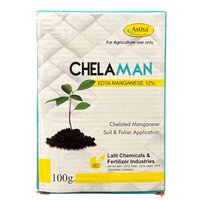
Chelated Manganese (EDTA Manganese 12%) is a straight micronutrient fertilizer registered under India's Fertilizer (Control) Order, 1985 (FCO). It supplies manganese in an EDTA-chelated, water-soluble form for foliar and fertigation use. Since fertilizers fall under the FCO rather than the Central Insecticides Board (CIB), the crop, symptom and dosage information on this page is drawn from agricultural-university package-of-practices guidance on manganese deficiency management, along with the product's own FCO label application rate. It is a different manganese chemistry to manganese carbonate (SC) fertilizers — the chelated EDTA form is used mainly for fast, foliar correction rather than bulk basal soil application.
Which Deficiency Symptom Is This For? (Symptom Guide)
Manganese deficiency is common on alkaline, calcareous soils and over-limed fields where manganese becomes chemically locked up even when total soil manganese is adequate. The table below lists crops where this deficiency is typically seen and its field symptoms.
| Crop | Other Names | What You'll See in the Field |
|---|---|---|
| Wheat | — | Interveinal chlorosis on younger leaves with grey-brown necrotic flecking ("grey speck"), soft plants prone to lodging, delayed maturity |
| Paddy (Rice) | — | Interveinal yellow-green striping on younger leaves, stunted growth and reduced tillering on high-pH soils |
| Soybean / pulses | — | Interveinal chlorosis between fine green veins on younger leaves, stunted growth on calcareous soils |
| Citrus (e.g. Kinnow) | — | Interveinal chlorosis with a fine green network along veins on younger leaves, reduced fruit size and yield |
| Vegetables (potato, onion) | — | Interveinal chlorosis on younger leaves, stunted growth on manganese-deficient calcareous soils |
Mode of Action
Manganese is an essential cofactor for enzymes involved in photosynthesis — specifically the oxygen-evolving complex of photosystem II — as well as respiration, lignin synthesis and nitrogen metabolism. Chelating manganese with EDTA keeps it in a soluble, plant-available form that resists being locked up by high soil pH or calcium carbonate, allowing rapid uptake through the leaf surface even where soil-applied manganese sources would quickly become unavailable. This makes the chelated form especially suited to fast corrective foliar sprays once deficiency symptoms are visible.
Features & Benefits
- Corrects manganese deficiency causing grey speck in wheat and interveinal chlorosis in paddy, soybean, citrus and vegetables.
- EDTA chelation keeps manganese available even on alkaline and calcareous soils where ordinary manganese sources get locked up.
- Fast foliar absorption for quick correction once visible deficiency symptoms appear.
- Supports the photosynthetic and respiratory enzyme systems that depend on manganese as a cofactor.
- Compatible with most common foliar fertilizer and fertigation programmes at low use rates.
- Complements manganese carbonate (SC) basal soil treatments as a rapid top-up where deficiency is already visible.
Recommended Usage
Chelated micronutrient EDTA products are applied at low, percentage-based foliar concentrations rather than a bulk per-acre rate. The doses below reflect the commonly followed rate for 12% chelated manganese EDTA foliar sprays and the product's own FCO label directions.
| Crop | Recommended Dose | Water Volume | Application Timing / Method |
|---|---|---|---|
| Wheat | 1–2 g per litre of water | 150–200 litres/acre | Foliar spray as soon as grey-speck symptoms appear; repeat after 10–15 days if needed |
| Paddy (Rice) | 1–2 g per litre of water | 150–200 litres/acre | Foliar spray during active tillering on high-pH/deficient soils |
| Soybean / pulses | 1–1.5 g per litre of water | 150–200 litres/acre | Foliar spray at early vegetative stage on calcareous soils |
| Citrus (e.g. Kinnow) | 1.5–2 g per litre of water | As required for full canopy coverage | Foliar spray at each new growth flush; repeat at 15–20 day intervals if symptoms persist |
| Vegetables (potato, onion) | 1–1.5 g per litre of water | 150–200 litres/acre | Foliar spray at early growth stage; repeat once if deficiency persists |
These are percentage/concentration-based foliar spray rates, as is standard for EDTA-chelated micronutrients — the small quantity of active manganese needed per plant means a per-acre bulk figure is not meaningful the way it is for bulk soil fertilizers; mix the stated grams per litre of water and spray to the point of leaf run-off. Rates are based on commonly followed agricultural-extension practice for chelated manganese EDTA and the product's own FCO label; confirm the exact label rate and always patch-test on a small area before a full-field spray.
How to Use
- Confirm manganese deficiency before spraying — look for grey speck in wheat or interveinal chlorosis in other crops, and where possible confirm with a soil test, especially on high-pH or calcareous soils.
- Dissolve the required quantity completely in the specified water volume; chelated manganese is fully water-soluble and does not need a separate wetting agent.
- Spray to the point of run-off using a knapsack or power sprayer fitted with a fine nozzle for even leaf coverage, including the underside of leaves.
- Apply during the cooler part of the day (early morning or evening) to reduce evaporation and the risk of leaf scorch.
- Avoid mixing with strongly alkaline pesticides or fertilizers unless compatibility is confirmed, as this can affect chelate stability.
- Repeat only if deficiency symptoms persist after the first spray; avoid routine repeated use on soils that are not manganese-deficient.
Precautions & Safety
- Wear gloves and a mask while handling, mixing and applying, as a routine precaution for any fertilizer input.
- Avoid foliar spraying during peak heat, bright sunshine or before rain.
- Keep away from direct contact with eyes and skin; wash immediately with water if contact occurs.
- Do not exceed the recommended concentration — excess concentration can cause leaf scorch.
- Store in the original, tightly closed pack in a cool, dry place away from direct sunlight, and out of reach of children and livestock.
- Wash hands, face and any exposed skin thoroughly with soap and water after handling or spraying.
Brand names mentioned on this page are registered trademarks of their respective owners and are referenced here for identification purposes only; FarmMate is not affiliated with or endorsed by these brands. This page is for general information only — always consult your local agricultural extension office and confirm the current product label before use.
Explore other technical usage guides on FarmMate.in
Fertilizers8
Micronutrients9
Fungicides34
- Azoxystrobin 11% + Tebuconazole 18.3% SC
- Azoxystrobin 18.2% + Difenoconazole 11.4% SC
- Azoxystrobin 23% SC
- Azoxystrobin 11.5% + Mancozeb 30% WP
- Azoxystrobin 4.8% + Chlorothalonil 40% SC
- Captan 70% + Hexaconazole 5% WP
- Carbendazim 12% + Mancozeb 63% WP
- Carbendazim 46.27% SC
- Carbendazim 50% WP
- Copper Oxychloride 50% WP
- Cymoxanil 8% + Mancozeb 64% WP
- Hexaconazole 5% SC
- Isoprothiolane 40% EC
- Mancozeb 75% WP
- Metalaxyl 35% WS
- Metalaxyl 8% + Mancozeb 64% WP
- Propiconazole 25% EC
- Propineb 70% WP
- Streptomycin Sulphate 9% + Tetracycline Hydrochloride 1%
- Sulphur 80% WDG
- Tebuconazole 10% + Sulphur 65% WG
- Tebuconazole 25.9% EC
- Tebuconazole 25% WG
- Tebuconazole 2% DS
- Tebuconazole 50% + Trifloxystrobin 25% WG
- Tebuconazole 6.7% + Captan 26.9% SC
- Thifluzamide 24% SC
- Tebuconazole 38.39% SC
- Thiophanate Methyl 70% WP
- Tricyclazole 75% W.P.
- Validamycin 3% L
- Ziram 27% SC
- Propiconazole 13.9% + Difenoconazole 13.9% EC
- Kasugamycin 3% SL
Herbicides24
- 2,4-D Amine Salt 58% SL
- Bispyribac Sodium 10% SC
- Clodinafop Propargyl 15% WP
- Ethoxysulfuron 15% WDG
- Glufosinate Ammonium 13.5% SL
- Isoproturon 75% WP
- Mesotrione 2.27% + Atrazine 22.7% SC
- Metribuzin 70% WP
- Metsulfuron Methyl 20% WP
- Pendimethalin 30% EC
- Pendimethalin 38.7% CS
- Pinoxaden 5.1% EC
- Pretilachlor 37% EW
- Pretilachlor 50% EC
- Pyrazosulfuron Ethyl 10% WP
- Atrazine 50% WP
- Clodinafop Propargyl 9% + Metribuzin 20% WP
- Fenoxaprop-p-ethyl 9.3% EC
- Halosulfuron Methyl 75% WG
- Oxyfluorfen 23.5% EC
- Pyroxasulfone 85% WG
- Sulfosulfuron 75% WG
- Sulfosulfuron 75% + Metsulfuron Methyl 5% WG
- Tembotrione 34.4% SC
Insecticides39
- Acetamiprid 20% SP
- Bifenthrin 10% EC
- Buprofezin 25% SC
- Chlorantraniliprole 0.4% GR
- Chlorantraniliprole 35% WG
- Chlorantraniliprole 8.8% + Thiamethoxam 17.5% SC
- Chlorantraniliprole 9.3% + Lambda Cyhalothrin 4.6% ZC
- Chlorpyrifos 50% + Cypermethrin 5% EC
- Chlorpyriphos 20% EC
- Chlorpyriphos 50% EC
- Clothianidin 50% WG
- Dimethoate 30% EC
- Dinotefuran 15% + Pymetrozine 45% WG
- Dinotefuran 20% SG
- Emamectin Benzoate 1.5% + Fipronil 3.5% SC
- Emamectin Benzoate 1.9% EC
- Emamectin Benzoate 5% SG
- Fipronil 18.87% SC
- Fipronil 40% + Imidacloprid 40% WG
- Fipronil 5% SC
- Fipronil 80% WG
- Flonicamid 50% WG
- Imidacloprid 17.8% SL
- Imidacloprid 30.5% SC
- Imidacloprid 70% WG
- Lambda Cyhalothrin 10% WP
- Lambda Cyhalothrin 4.9% CS
- Lambda Cyhalothrin 5% EC
- Novaluron 5.25% + Indoxacarb 4.5% SC
- Permethrin 25% EC
- Profenofos 40% + Cypermethrin 4% EC
- Pymetrozine 50% WG
- Pyriproxyfen 10% EC
- Pyriproxyfen 5% + Diafenthiuron 25% SE
- Quinalphos 25% EC
- Chlorantraniliprole 18.5% SC
- Thiamethoxam 12.6% + Lambda Cyhalothrin 9.5% ZC
- Thiamethoxam 25% WG
- Thiamethoxam 30% FS