
Metsulfuron Methyl 20% WP Herbicide Uses
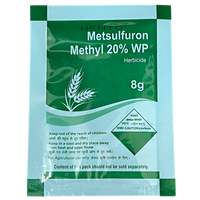
Currently none of our products with this technical are in stock. Please check back soon, or browse our full product range.
Metsulfuron Methyl 20% WP is a selective, systemic, post-emergence herbicide from the sulfonylurea group, registered for use in India under the Insecticides Act, 1968. It is applied as a foliar spray, usually with a surfactant, to actively growing weeds in wheat, transplanted rice and sugarcane, and is absorbed through both the leaves and roots of target weeds at very low use rates. This page lists its mode of action, key benefits and the recommended crop-wise dosage as per CIB-registered labels.
Which Weeds Does This Control? (Field Identification Guide)
Not sure whether what's coming up in your wheat, rice or sugarcane field falls within this herbicide's control range? This guide helps you identify the weeds it targets so you can confirm before spraying.
| Crop | Weed (Common Name) | How to Recognise It |
|---|---|---|
| Wheat | Chenopodium album — commonly called "बथुआ" (Bathua) by farmers | Broadleaf weed with a mealy, greyish-white coating on young leaves; leaves are diamond/goosefoot-shaped, and the plant grows upright and branches heavily if left uncontrolled. |
| Wheat | Melilotus indica — commonly called "सेंजी" (Senji) by farmers, or yellow sweet clover | Upright, branching broadleaf weed with clover-like leaves in groups of three and small, fragrant yellow flowers held on slender spikes; can grow as tall as the wheat crop itself if uncontrolled. |
| Wheat | Lathyrus aphaca — known as yellow pea / wild pea | Climbing/sprawling legume weed with tendrils in place of true leaves, broad leaf-like stipules at the base, and small yellow pea-type flowers; twines around wheat stems and can cause lodging in patches. |
| Wheat | Anagallis arvensis — known as scarlet pimpernel | Low, spreading broadleaf weed with small oval leaves in opposite pairs along square-ish stems, and tiny orange-red (occasionally blue) five-petalled flowers that open only in sunlight. |
| Wheat | Vicia sativa — known as common vetch | Climbing legume weed with tendrilled, feather-like compound leaves and small purple-pink pea-type flowers; scrambles over wheat plants using its tendrils, similar in habit to Lathyrus aphaca. |
| Wheat | Cirsium arvense — known as Canada thistle | Upright broadleaf weed with spiny-edged, deeply lobed leaves and small purple-pink tufted flower heads; spreads through creeping roots, so a small patch can expand quickly across a field over seasons. |
| Transplanted Rice | Cyperus rotundus — commonly called "मोथा" or "नागरमोथा" (Motha / Nagarmotha) by farmers, or purple nutsedge | Grass-like sedge with a triangular stem and dark green, glossy leaves, spreading through underground tubers that make it very persistent in the field. |
| Transplanted Rice | Fimbristylis spp. — known as Hoora grass | Small, densely tufted sedge with very thin, wiry, three-angled stems and tiny clustered brownish flower heads; easy to mistake for young Cyperus but has noticeably finer foliage. |
| Transplanted Rice | Ludwigia parviflora — commonly called "बनलौंग" (Ban Long) by farmers, or water primrose | Broadleaf weed of standing-water fields with narrow, lance-shaped leaves and small four-petalled yellow flowers close to the leaf joints; stems are often reddish and somewhat fleshy. |
| Sugarcane | Amaranthus viridis — commonly called "चौलाई" (Choulai) by farmers, or slender amaranth / pigweed | Fast-growing broadleaf weed with smooth, diamond-to-oval shaped leaves on long stalks, and slim, upright green flower spikes at the stem tips; often confused with the edible chaulai leafy vegetable, so check the field to confirm before pulling by hand. |
| Sugarcane | Portulaca oleracea — commonly called "कुलफा" (Kulfa) by farmers, or common purslane | Low, fleshy, spreading broadleaf weed with thick, paddle-shaped leaves and reddish stems that hold moisture, making it drought-tolerant and able to re-root from cut fragments left on the soil. |
| Sugarcane | Parthenium hysterophorus — commonly called "गाजर घास" (Gajar Ghas) by farmers, or congress grass | Upright weed with finely divided, carrot-leaf-like foliage and small white flower heads; can cause skin allergy/irritation on contact, so it's best avoided during hand-weeding. |
| Sugarcane | Commelina benghalensis — known as tropical spiderwort / dayflower | Sprawling, mat-forming weed with smooth, pointed-oval leaves that clasp the stem, and small three-petalled blue flowers; spreads readily from stem fragments left after cultivation, so it regrows quickly if not removed fully. |
Mode of Action
Metsulfuron methyl belongs to the sulfonylurea class of herbicides and works by inhibiting acetolactate synthase (ALS), an enzyme weeds need to produce the branched-chain amino acids valine, leucine and isoleucine. Without these amino acids, protein synthesis and cell division stop in the weed's growing points. It is systemic and effective at very low doses, taken up through both the leaves and roots of actively growing weeds and moved within the plant to the shoot and root tips. Treated weeds typically stop growing within a few days, show yellowing/purpling, and gradually die over one to three weeks, while the labelled crops tolerate the herbicide at the labelled dose and stage.
Features & Benefits
- Post-emergence, foliar-and-root-acting control effective at very low use rates per acre across three different crops — wheat, transplanted rice and sugarcane.
- Broad-spectrum activity on broadleaf weeds (Chenopodium album, Melilotus indica, Lathyrus aphaca, Anagallis arvensis, Vicia sativa, Cirsium arvense, Amaranthus viridis, Portulaca oleracea, Parthenium hysterophorus, Commelina benghalensis) plus sedges (Cyperus rotundus, Fimbristylis spp.) and a broadleaf aquatic weed (Ludwigia parviflora) depending on the crop.
- Wettable powder (WP) formulation, typically applied with a non-ionic surfactant to improve leaf coverage and uptake — check the current label for the surfactant rate.
- Low per-acre application volume makes it convenient for knapsack sprayers on smaller wheat and rice holdings.
Recommended Usage of Metsulfuron Methyl 20% WP Herbicide
The table below gives the CIB-registered dose, water volume, timing and waiting period per acre, converted from the official per-hectare rate (1 hectare ≈ 2.47 acres). Always confirm against the current product label before use, including the surfactant addition rate.
| Crop | Target Weeds | Dose per Acre | Water Volume | Application Timing | Waiting Period (PHI) |
|---|---|---|---|---|---|
| Wheat | Chenopodium album, Melilotus indica, Lathyrus aphaca, Anagallis arvensis, Vicia sativa, Cirsium arvense | ≈1.6 g a.i. (≈8 g formulation) + label-directed surfactant | ≈200–245 litres | Post-emergence, on actively growing weeds | 80 days |
| Transplanted Rice | Cyperus rotundus, Sphenoclea spp., Fimbristylis spp., Ludwigia parviflora, Marsilea quadrifolia | ≈1.6 g a.i. (≈8 g formulation) | ≈200–245 litres | Post-emergence, on actively growing weeds | 60 days |
| Sugarcane | Cyperus esculentus, Amaranthus viridis, Portulaca oleracea, Parthenium hysterophorus, Trianthema spp., Cleome viscosa, Solanum spp., Commelina benghalensis, Euphorbia spp., Digera spp. | ≈2.4 g a.i. (≈12 g formulation) + label-directed non-ionic surfactant | ≈200–245 litres | Post-emergence, on actively growing weeds | 346 days |
Doses above are converted from the CIB-registered per-hectare rate (wheat and rice: 4 g a.i./ha, 20 g formulation/ha; sugarcane: 6 g a.i./ha, 30 g formulation/ha; 500–600 litres water/ha across all three) for Metsulfuron Methyl 20% WP. The sugarcane PHI of 346 days reflects the crop's long growing season, not an unusually persistent residue. Always confirm the current pack label/CIB registration and consult your local agricultural extension office before use and before harvest.
How to Use
- Apply when weeds are small and actively growing, as per the timing on the current label; larger, well-established weeds are harder to control.
- Mix the required quantity of Metsulfuron Methyl 20% WP into the spray tank and agitate well; add the surfactant specified on the current label at the correct rate, since it significantly improves leaf coverage and uptake for this herbicide.
- In transplanted rice, drain standing water from the field or reduce it to a thin film before spraying, so the spray reaches weed foliage directly rather than being diluted by floodwater.
- Spray uniformly using a knapsack or power sprayer fitted with a flat-fan nozzle, ensuring even coverage of weed foliage.
- In rice, re-flood the field with a thin layer of water only after the spray has dried on the leaves, typically after a few hours, as per current label directions.
- Avoid spraying during strong wind or if rain is expected within a few hours, as this can reduce weed uptake and control.
Precautions & Safety
- Wear appropriate PPE — mask, gloves, goggles and full-sleeved clothing — while mixing and spraying.
- Measure the small quantities required carefully, since this herbicide is used at very low per-acre doses and small errors can significantly affect the actual rate applied.
- Apply only at the correct crop stage and dose given above; do not drain the field immediately before spraying or re-flood too soon after in rice, as both reduce weed control.
- Store in the original, tightly closed container in a cool, dry place away from direct sunlight, food, feed and out of reach of children and livestock.
- Respect the labelled waiting period (PHI) for each crop — 80 days for wheat, 60 days for transplanted rice, 346 days for sugarcane — before harvest, and follow your local agricultural extension advice for the latest guidance.
- Metsulfuron methyl is an ALS-inhibitor (Group 2) herbicide; avoid repeated, back-to-back use of the same mode of action on the same field across seasons, and rotate herbicide groups as part of a resistance-management program.
- Follow label guidance on crop rotation before planting a different, sensitive crop in a treated field, since sulfonylurea residues can affect certain follow-on crops.
- Wash hands, face and any exposed skin thoroughly with soap and water after handling or spraying, and change out of contaminated clothing before eating, drinking or smoking.
Brand names mentioned on this page are registered trademarks of their respective owners and are referenced here for identification purposes only; FarmMate is not affiliated with or endorsed by these brands. This page is for general information only — always consult your local agricultural extension office and confirm the current product label before use.
Explore other technical usage guides on FarmMate.in
Fertilizers2
Fungicides22
- Azoxystrobin 11% + Tebuconazole 18.3% SC
- Azoxystrobin 18.2% + Difenoconazole 11.4% SC
- Captan 70% + Hexaconazole 5% WP
- Carbendazim 12% + Mancozeb 63% WP
- Carbendazim 46.27% SC
- Carbendazim 50% WP
- Copper Oxychloride 50% WP
- Hexaconazole 5% SC
- Isoprothiolane 40% EC
- Mancozeb 75% WP
- Metalaxyl 35% WS
- Propiconazole 25% EC
- Streptomycin Sulphate 9% + Tetracycline Hydrochloride 1%
- Sulphur 80% WDG
- Tebuconazole 10% + Sulphur 65% WG
- Tebuconazole 25.9% EC
- Tebuconazole 50% + Trifloxystrobin 25% WG
- Tebuconazole 6.7% + Captan 26.9% SC
- Thiophanate Methyl 70% WP
- Tricyclazole 75% W.P.
- Validamycin 3% L
- Ziram 27% SC
Herbicides14
- 2,4-D Amine Salt 58% SL
- Bispyribac Sodium 10% SC
- Clodinafop Propargyl 15% WP
- Ethoxysulfuron 15% WDG
- Glufosinate Ammonium 13.5% SL
- Isoproturon 75% WP
- Mesotrione 2.27% + Atrazine 22.7% SC
- Metribuzin 70% WP
- Pendimethalin 30% EC
- Pendimethalin 38.7% CS
- Pinoxaden 5.1% EC
- Pretilachlor 37% EW
- Pretilachlor 50% EC
- Pyrazosulfuron Ethyl 10% WP
Insecticides21
- Acetamiprid 20% SP
- Bifenthrin 10% EC
- Buprofezin 25% SC
- Chlorantraniliprole 18.5% SC
- Chlorpyriphos 20% EC
- Chlorpyriphos 50% EC
- Clothianidin 50% WG
- Dinotefuran 20% SG
- Emamectin Benzoate 1.9% EC
- Emamectin Benzoate 5% SG
- Fipronil 40% + Imidacloprid 40% WG
- Fipronil 5% SC
- Imidacloprid 30.5% SC
- Imidacloprid 70% WG
- Lambda Cyhalothrin 5% EC
- Profenofos 40% + Cypermethrin 4% EC
- Pymetrozine 50% WG
- Pyriproxyfen 10% EC
- Thiamethoxam 12.6% + Lambda Cyhalothrin 9.5% ZC
- Thiamethoxam 25% WG
- Thiamethoxam 30% FS