
Zinc Oxide 39.5% SC – Uses, Dosage & Application
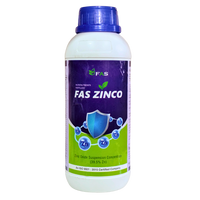
Currently none of our products with this technical are in stock. Please check back soon, or browse our full product range.
Zinc Oxide 39.5% SC is a suspension-concentrate (liquid) micronutrient fertilizer registered for use in India under the Fertilizer (Control) Order, 1985 (FCO) — a plant-nutrition product, not a crop-protection one. Zinc is an essential micronutrient for enzyme activity, auxin (growth hormone) synthesis and chlorophyll formation, and its deficiency is one of the most widespread micronutrient problems in Punjab and North Indian soils. This liquid suspension form is highly concentrated and gives fine, uniform particle dispersion when diluted, which supports good leaf coverage in a foliar spray. Dosage guidance on this page draws on Punjab Agricultural University (PAU) Package of Practices and ICAR recommendations for zinc nutrition, read alongside the product's own FCO label application rate for this liquid SC formulation.
Which Deficiency Symptom Is This For? (Symptom Guide)
Not sure whether what you're seeing in the field is zinc deficiency? This guide helps match the visible symptom to the crop before deciding on a spray.
| Crop | Other Names | What You'll See in the Field |
|---|---|---|
| Rice (Paddy) | Khaira disease ("खैरा रोग"). | Appears 2–3 weeks after transplanting: brown blotches and streaks on the lower/older leaves, bronzing from the leaf margin inward while the midrib stays green, stunted growth and reduced tillering. |
| Wheat | Interveinal chlorosis / bronzing. | Pale yellow to whitish interveinal streaks on younger leaves, stunted and thin tillers, delayed heading — most common on light, sandy, calcareous soils. |
| Maize | "White bud" disease. | Broad white to pale-yellow bands running parallel to the midrib on either side of the base of young leaves, shortened internodes, and a stunted, bushy appearance in severe cases. |
| Cotton | "Little leaf" / rosetting. | Leaves emerge small, narrow and mottled with interveinal yellowing; internodes shorten, giving the plant a bushy, rosette-like appearance with reduced boll set. |
| Sugarcane | Chlorotic mottling. | Yellowish-white chlorotic bands on young leaves, narrow leaf blades, stunted cane growth and delayed tillering, especially on sandy or heavily leached soils. |
Mode of Action
Zinc Oxide 39.5% SC supplies zinc as an ultra-fine suspension of zinc oxide particles, which disperses evenly when mixed with water, giving a large effective surface area for rapid uptake through the leaf surface once sprayed. Zinc functions as a cofactor for numerous plant enzymes, plays a central role in synthesis of the growth hormone auxin (IAA), and supports chlorophyll formation and protein synthesis; healthy zinc status is essential for normal internode elongation and leaf expansion, which is why deficiency shows up as stunted, rosetted growth. As a concentrated liquid suspension rather than a dry salt, this formulation mixes into a spray tank quickly without residue and is well suited to both foliar spray and drip fertigation use.
Features & Benefits
- High-concentration (39.5% Zn) liquid suspension that disperses evenly in the spray tank without clumping or residue.
- Corrects khaira disease in paddy, white bud in maize, little leaf in cotton and interveinal chlorosis in wheat and sugarcane.
- Fine particle size supports rapid foliar uptake and a visible greening response within days of spraying on deficient crops.
- Low dose-per-litre requirement due to high zinc concentration, reducing the volume of product needed per tank.
- Suitable for both foliar spray and drip fertigation application.
- Compatible with most common fertilizers and crop-protection products in a tank mix (a jar-compatibility test is still recommended before mixing).
Recommended Usage of Zinc Oxide 39.5% SC Fertilizer
PAU package-of-practices and ICAR recommendations for zinc correction are generally expressed for zinc sulphate as a percentage foliar-spray concentration; the table below gives this liquid SC formulation's dose per its own FCO label, expressed in millilitres per litre of water since it is a concentrated liquid suspension rather than a dry powder.
| Crop | Recommended Dose | Water Volume | Application Timing/Method |
|---|---|---|---|
| Wheat | 1.0–1.5 ml per litre | As a fine foliar spray to full coverage | First spray 30–35 days after sowing, repeated at 40–45 days if symptoms persist |
| Rice (Paddy) | 1.0–1.5 ml per litre | As a fine foliar spray to full coverage | First spray 30–35 days after transplanting, repeated at 45–50 days on affected patches |
| Maize | 1.0–1.5 ml per litre | As a fine foliar spray to full coverage | At knee-high stage (30–35 days after sowing), repeated 10–15 days later in severely deficient fields |
| Cotton | 1.0–1.5 ml per litre (or approx. 0.3–1 litre/acre in high-volume spray) | As a fine foliar spray to full coverage | 3–4 weeks after emergence, repeated every 10–14 days if symptoms persist |
| Sugarcane | 1.0–1.5 ml per litre | As a fine foliar spray to full coverage | At 45 days and again at 90 days after planting |
Doses above are expressed as millilitres per litre of water rather than a per-acre quantity because this is a concentrated liquid suspension dosed by spray-solution strength, in line with how PAU/ICAR and FCO product labels present chelated/liquid micronutrient rates; the cotton figure in litres/acre is an alternative high-volume-spray reference from the product's FCO label. Always confirm the current product label before use and consult your local agricultural extension office for soil-test-based recommendations.
How to Use
- Confirm zinc deficiency symptoms against the Symptom Guide above, and where possible get a soil or tissue test done through your local Krishi Vigyan Kendra (KVK) to confirm zinc status.
- Shake the container well before use, then measure the required quantity of Zinc Oxide 39.5% SC and add it to the spray tank already part-filled with water, stirring continuously before topping up to the required volume.
- Spray using a knapsack or power sprayer fitted with a flat-fan or fine mist nozzle, ensuring uniform coverage of both leaf surfaces.
- Spray during the early morning or late evening to reduce evaporation and improve leaf uptake; avoid spraying in strong sunlight or just before rain.
- Repeat the spray at the interval given in the table above if deficiency symptoms persist in new growth.
Precautions & Safety
- Wear basic protective clothing and gloves while mixing and spraying, as a routine precaution for any agricultural input.
- Shake well before every use, since being a suspension concentrate, the zinc oxide particles can settle during storage.
- Do not exceed the recommended concentration — spraying zinc at a higher-than-labelled concentration can cause leaf scorch rather than faster correction.
- Store in the original, tightly closed container in a cool, dry place away from direct sunlight, food, feed and out of reach of children and livestock; protect from freezing.
- This foliar fertilizer is a supplement to, not a replacement for, balanced soil fertilization — follow your local agricultural extension advice on fitting it into your overall soil-nutrition programme.
- Wash hands, face and any exposed skin thoroughly with soap and water after handling or spraying.
Brand names mentioned on this page are registered trademarks of their respective owners and are referenced here for identification purposes only; FarmMate is not affiliated with or endorsed by these brands. This page is for general information only — always consult your local agricultural extension office and confirm the current product label before use.
Explore other technical usage guides on FarmMate.in
Fertilizers8
Micronutrients9
Fungicides34
- Azoxystrobin 11% + Tebuconazole 18.3% SC
- Azoxystrobin 18.2% + Difenoconazole 11.4% SC
- Azoxystrobin 23% SC
- Azoxystrobin 11.5% + Mancozeb 30% WP
- Azoxystrobin 4.8% + Chlorothalonil 40% SC
- Captan 70% + Hexaconazole 5% WP
- Carbendazim 12% + Mancozeb 63% WP
- Carbendazim 46.27% SC
- Carbendazim 50% WP
- Copper Oxychloride 50% WP
- Cymoxanil 8% + Mancozeb 64% WP
- Hexaconazole 5% SC
- Isoprothiolane 40% EC
- Mancozeb 75% WP
- Metalaxyl 35% WS
- Metalaxyl 8% + Mancozeb 64% WP
- Propiconazole 25% EC
- Propineb 70% WP
- Streptomycin Sulphate 9% + Tetracycline Hydrochloride 1%
- Sulphur 80% WDG
- Tebuconazole 10% + Sulphur 65% WG
- Tebuconazole 25.9% EC
- Tebuconazole 25% WG
- Tebuconazole 2% DS
- Tebuconazole 50% + Trifloxystrobin 25% WG
- Tebuconazole 6.7% + Captan 26.9% SC
- Thifluzamide 24% SC
- Tebuconazole 38.39% SC
- Thiophanate Methyl 70% WP
- Tricyclazole 75% W.P.
- Validamycin 3% L
- Ziram 27% SC
- Propiconazole 13.9% + Difenoconazole 13.9% EC
- Kasugamycin 3% SL
Herbicides24
- 2,4-D Amine Salt 58% SL
- Bispyribac Sodium 10% SC
- Clodinafop Propargyl 15% WP
- Ethoxysulfuron 15% WDG
- Glufosinate Ammonium 13.5% SL
- Isoproturon 75% WP
- Mesotrione 2.27% + Atrazine 22.7% SC
- Metribuzin 70% WP
- Metsulfuron Methyl 20% WP
- Pendimethalin 30% EC
- Pendimethalin 38.7% CS
- Pinoxaden 5.1% EC
- Pretilachlor 37% EW
- Pretilachlor 50% EC
- Pyrazosulfuron Ethyl 10% WP
- Atrazine 50% WP
- Clodinafop Propargyl 9% + Metribuzin 20% WP
- Fenoxaprop-p-ethyl 9.3% EC
- Halosulfuron Methyl 75% WG
- Oxyfluorfen 23.5% EC
- Pyroxasulfone 85% WG
- Sulfosulfuron 75% WG
- Sulfosulfuron 75% + Metsulfuron Methyl 5% WG
- Tembotrione 34.4% SC
Insecticides39
- Acetamiprid 20% SP
- Bifenthrin 10% EC
- Buprofezin 25% SC
- Chlorantraniliprole 0.4% GR
- Chlorantraniliprole 35% WG
- Chlorantraniliprole 8.8% + Thiamethoxam 17.5% SC
- Chlorantraniliprole 9.3% + Lambda Cyhalothrin 4.6% ZC
- Chlorpyrifos 50% + Cypermethrin 5% EC
- Chlorpyriphos 20% EC
- Chlorpyriphos 50% EC
- Clothianidin 50% WG
- Dimethoate 30% EC
- Dinotefuran 15% + Pymetrozine 45% WG
- Dinotefuran 20% SG
- Emamectin Benzoate 1.5% + Fipronil 3.5% SC
- Emamectin Benzoate 1.9% EC
- Emamectin Benzoate 5% SG
- Fipronil 18.87% SC
- Fipronil 40% + Imidacloprid 40% WG
- Fipronil 5% SC
- Fipronil 80% WG
- Flonicamid 50% WG
- Imidacloprid 17.8% SL
- Imidacloprid 30.5% SC
- Imidacloprid 70% WG
- Lambda Cyhalothrin 10% WP
- Lambda Cyhalothrin 4.9% CS
- Lambda Cyhalothrin 5% EC
- Novaluron 5.25% + Indoxacarb 4.5% SC
- Permethrin 25% EC
- Profenofos 40% + Cypermethrin 4% EC
- Pymetrozine 50% WG
- Pyriproxyfen 10% EC
- Pyriproxyfen 5% + Diafenthiuron 25% SE
- Quinalphos 25% EC
- Chlorantraniliprole 18.5% SC
- Thiamethoxam 12.6% + Lambda Cyhalothrin 9.5% ZC
- Thiamethoxam 25% WG
- Thiamethoxam 30% FS