
NPK 00:00:50 Fertilizer Uses
Currently none of our products with this technical are in stock. Please check back soon, or browse our full product range.
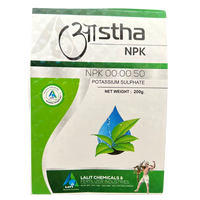
NPK 00:00:50 is a fully water-soluble, high-potash fertilizer grade supplying potassium (K₂O) along with sulphur, with no nitrogen or phosphorus, applied as a foliar spray or through drip fertigation. Fertilizers fall under India's Fertilizer (Control) Order 1985 (FCO), not the Insecticides Act — so unlike the crop-protection technicals on this site, this page is not CIB-registered content. It draws on PAU (Punjab Agricultural University) Package of Practices research on potassium nitrate foliar sprays, along with general ICAR guidance for high-potash water-soluble fertilizers. This page lists its role in plant nutrition, key benefits and recommended application.
Which Growth Stage Is This For?
Being nitrogen-free and potassium-rich, this grade is generally matched to the flowering, fruit-development and maturation stages, when the crop's potassium demand for fruit quality, size and stress tolerance is highest — not to the early vegetative stage. The table below maps common crop groups to the growth stage this grade is typically used at.
| Crop | Growth Stage | Why This Grade Helps |
|---|---|---|
| Citrus (Kinnow, etc.) | Fruit development to maturity | PAU-recommended potassium nitrate sprays improve fruit size, colour and juice quality |
| Paddy (Rice) | Boot stage | PAU research shows potassium nitrate at boot stage reduces spikelet sterility |
| Wheat | Boot leaf and anthesis (flowering) | PAU-recommended potassium nitrate spray helps offset high-temperature stress during grain filling |
| Cotton | Boll development | Potassium supports boll retention, fibre development and stress tolerance |
| Vegetables & Fruits (general) | Flowering to fruit maturation | Improves fruit size, sugar content, colour and shelf life |
Mode of Action / Nutrient Role
NPK 00:00:50 supplies potassium (K₂O) and sulphur in fully water-soluble form, allowing rapid uptake through foliar absorption or the root zone under fertigation. Potassium regulates stomatal opening and water movement within the plant, activates enzymes involved in sugar transport and starch formation, and strengthens the plant's tolerance to heat, water stress, pests and disease. Because it carries no nitrogen, this grade is used at the reproductive and fruit-development stages — when the crop's demand for potassium relative to nitrogen rises sharply — to improve fruit size, sugar content, colour and overall produce quality, and, per PAU trials on cereals, to reduce sterility/heat-stress losses at flowering.
Features & Benefits
- Fully water-soluble, nitrogen-free source of potassium and sulphur, suited to the fruiting/maturation stage of most crops.
- PAU Package of Practices research-backed use on Kinnow (fruit quality/size) and on wheat and paddy (heat-stress and sterility mitigation at flowering).
- Improves fruit size, sugar content, colour and uniformity, and strengthens tolerance to pest/disease pressure and weather stress.
- Suitable for both foliar spray and drip fertigation use across field crops, vegetables and fruit crops.
- Compatible with most insecticides and fungicides for combined tank-mix application in many cases (always confirm compatibility before mixing).
Recommended Usage of NPK 00:00:50 Fertilizer
The table below gives PAU (Punjab Agricultural University) Package of Practices-recommended potassium nitrate foliar-spray rates for the specific Punjab crops PAU has published trial data for, plus a general ICAR-guidance range for other crops where PAU has not published a crop-specific rate for this exact grade.
| Crop | Dose & Water Volume | Growth Stage / Timing |
|---|---|---|
| Kinnow (Citrus) | 1.0% solution (10 g per litre of water) | Three sprays — end-May, June and July |
| Paddy (Rice) | 1.5% solution (3 kg in 200 litres of water per acre) | At boot stage, to reduce sterility |
| Wheat | Approx. 4 kg in 200 litres of water per acre (2% solution) | At boot-leaf and anthesis (flowering) stages, mainly under high-temperature conditions during grain filling |
| Other crops (general foliar guidance) | 0.5–1% solution (5–10 g per litre of water) | Flowering through fruit development/maturation stage |
The Kinnow, paddy and wheat rows above are drawn from PAU (Punjab Agricultural University) Package of Practices trial recommendations for potassium nitrate foliar sprays; PAU's own potassium nitrate grade is typically 13:00:45, so treat these rates as the closest published PAU reference for potassium-rich water-soluble foliar sprays rather than a rate tested on the exact 00:00:50 grade — confirm current PAU/ICAR advice for your specific crop and product before use. The "Other crops" row is a general ICAR-guidance concentration range, not a crop-specific PAU figure. Always consult your local PAU Krishi Vigyan Kendra (KVK) before finalising a spray schedule.
How to Use
- Identify your crop's current growth stage — this grade is generally applied from flowering through fruit development, not at early vegetative growth.
- Dissolve the required quantity fully in a small amount of water before adding to the spray tank, then top up to the full volume, or mix into the fertigation tank as per your drip system's schedule.
- Spray using a knapsack or power sprayer fitted with a fine mist nozzle for uniform coverage, preferably during the early morning or late evening to reduce evaporation and leaf scorch.
- Follow the PAU-recommended timing where available (e.g. boot stage for paddy, boot-leaf/anthesis for wheat, or the three-spray Kinnow schedule); for other crops, time applications to flowering through fruit maturation.
- If tank-mixing with an insecticide or fungicide, do a small jar-compatibility test first to confirm the products mix cleanly.
Precautions & Safety
- Wear basic protective clothing and gloves while mixing and spraying, as a routine precaution for any agricultural input.
- Avoid spraying during peak heat, bright sunshine or on wet foliage, since strong sun after spraying can scorch leaves and reduce nutrient absorption.
- Do not tank-mix with fertilizers or pesticides of incompatible chemical nature (e.g. strongly acidic/alkaline products, or those prone to precipitation with potassium/sulphate salts) without a jar test first.
- Store in the original, tightly closed container/pack in a cool, dry place away from direct sunlight, food, feed and out of reach of children and livestock.
- This foliar/fertigation fertilizer is a supplement to, not a replacement for, balanced soil fertilization — follow your local agricultural extension advice on fitting it into your overall soil-nutrition programme.
- Wash hands, face and any exposed skin thoroughly with soap and water after handling or spraying.
Brand names mentioned on this page are registered trademarks of their respective owners and are referenced here for identification purposes only; FarmMate is not affiliated with or endorsed by these brands. This page is for general information only — always consult your local agricultural extension office (PAU Krishi Vigyan Kendra) and confirm current recommendations before use.
Explore other technical usage guides on FarmMate.in
Fertilizers7
Micronutrients10
Fungicides34
- Azoxystrobin 11% + Tebuconazole 18.3% SC
- Azoxystrobin 18.2% + Difenoconazole 11.4% SC
- Azoxystrobin 23% SC
- Azoxystrobin 11.5% + Mancozeb 30% WP
- Azoxystrobin 4.8% + Chlorothalonil 40% SC
- Captan 70% + Hexaconazole 5% WP
- Carbendazim 12% + Mancozeb 63% WP
- Carbendazim 46.27% SC
- Carbendazim 50% WP
- Copper Oxychloride 50% WP
- Cymoxanil 8% + Mancozeb 64% WP
- Hexaconazole 5% SC
- Isoprothiolane 40% EC
- Mancozeb 75% WP
- Metalaxyl 35% WS
- Metalaxyl 8% + Mancozeb 64% WP
- Propiconazole 25% EC
- Propineb 70% WP
- Streptomycin Sulphate 9% + Tetracycline Hydrochloride 1%
- Sulphur 80% WDG
- Tebuconazole 10% + Sulphur 65% WG
- Tebuconazole 25.9% EC
- Tebuconazole 25% WG
- Tebuconazole 2% DS
- Tebuconazole 50% + Trifloxystrobin 25% WG
- Tebuconazole 6.7% + Captan 26.9% SC
- Thifluzamide 24% SC
- Tebuconazole 38.39% SC
- Thiophanate Methyl 70% WP
- Tricyclazole 75% W.P.
- Validamycin 3% L
- Ziram 27% SC
- Propiconazole 13.9% + Difenoconazole 13.9% EC
- Kasugamycin 3% SL
Herbicides24
- 2,4-D Amine Salt 58% SL
- Bispyribac Sodium 10% SC
- Clodinafop Propargyl 15% WP
- Ethoxysulfuron 15% WDG
- Glufosinate Ammonium 13.5% SL
- Isoproturon 75% WP
- Mesotrione 2.27% + Atrazine 22.7% SC
- Metribuzin 70% WP
- Metsulfuron Methyl 20% WP
- Pendimethalin 30% EC
- Pendimethalin 38.7% CS
- Pinoxaden 5.1% EC
- Pretilachlor 37% EW
- Pretilachlor 50% EC
- Pyrazosulfuron Ethyl 10% WP
- Atrazine 50% WP
- Clodinafop Propargyl 9% + Metribuzin 20% WP
- Fenoxaprop-p-ethyl 9.3% EC
- Halosulfuron Methyl 75% WG
- Oxyfluorfen 23.5% EC
- Pyroxasulfone 85% WG
- Sulfosulfuron 75% WG
- Sulfosulfuron 75% + Metsulfuron Methyl 5% WG
- Tembotrione 34.4% SC
Insecticides39
- Acetamiprid 20% SP
- Bifenthrin 10% EC
- Buprofezin 25% SC
- Chlorantraniliprole 0.4% GR
- Chlorantraniliprole 35% WG
- Chlorantraniliprole 8.8% + Thiamethoxam 17.5% SC
- Chlorantraniliprole 9.3% + Lambda Cyhalothrin 4.6% ZC
- Chlorpyrifos 50% + Cypermethrin 5% EC
- Chlorpyriphos 20% EC
- Chlorpyriphos 50% EC
- Clothianidin 50% WG
- Dimethoate 30% EC
- Dinotefuran 15% + Pymetrozine 45% WG
- Dinotefuran 20% SG
- Emamectin Benzoate 1.5% + Fipronil 3.5% SC
- Emamectin Benzoate 1.9% EC
- Emamectin Benzoate 5% SG
- Fipronil 18.87% SC
- Fipronil 40% + Imidacloprid 40% WG
- Fipronil 5% SC
- Fipronil 80% WG
- Flonicamid 50% WG
- Imidacloprid 17.8% SL
- Imidacloprid 30.5% SC
- Imidacloprid 70% WG
- Lambda Cyhalothrin 10% WP
- Lambda Cyhalothrin 4.9% CS
- Lambda Cyhalothrin 5% EC
- Novaluron 5.25% + Indoxacarb 4.5% SC
- Permethrin 25% EC
- Profenofos 40% + Cypermethrin 4% EC
- Pymetrozine 50% WG
- Pyriproxyfen 10% EC
- Pyriproxyfen 5% + Diafenthiuron 25% SE
- Quinalphos 25% EC
- Chlorantraniliprole 18.5% SC
- Thiamethoxam 12.6% + Lambda Cyhalothrin 9.5% ZC
- Thiamethoxam 25% WG
- Thiamethoxam 30% FS